How to Create a Symptom Report Your Doctor Can Actually Use (And Why We Designed Fine This Way)
12 min read · July 1, 2026
By Tamara Schebel · Founder, Fine.
Whether you're tracking perimenopause symptoms, ADHD symptoms, medication side effects, anxiety, or another chronic health condition, a symptom report can help you and your doctor see patterns that are almost impossible to spot from memory alone.
A good symptom report shows patterns over time, medication changes, menstrual cycle timing, and whether symptoms are improving or worsening. That's exactly what Fine was designed to create.
The Fine Clinician Report is a printable symptom report that summarizes more than 100 perimenopause, ADHD, mental health, and medication tracking data points into an easy-to-read weekly timeline for your doctor or healthcare provider.
This report is especially helpful for people managing conditions where symptoms fluctuate over time, including perimenopause, ADHD, anxiety, depression, thyroid conditions, PMDD, medication changes, or any combination of them.
Menopause Foundation of Canada: take charge of your care guide
If you've ever sat in a doctor's office and been asked:
"So... how have you been feeling over the last few months?"
...you've probably answered something like: "Umm... ok, I guess."
Not because you weren't paying attention. Because you genuinely couldn't remember.
If you've already read Why Symptom Tracking Is So Hard During Perimenopause and ADHD, you'll know that remembering symptoms over several months is surprisingly difficult.
Which is a bit of a problem when you're trying to figure out whether a new medication is working, whether your symptoms are getting worse, or whether that thing you experienced three weeks ago happened once... or twenty times.
It's also the reason I built Fine.
The Fine Clinician Report was designed to answer one simple question: How do we make months of messy, overlapping symptoms easy for both patients and doctors to understand?
Here's why it looks the way it does.
Doctors don't diagnose snapshots. They diagnose patterns.
Most doctor's appointments happen every few months.
Perimenopause symptoms don't.
Some days you feel almost normal. Some days you can't remember your own phone number. Some weeks you're sleeping beautifully. Other weeks you're awake at 3am wondering if you're losing your mind.
When your doctor asks how you've been feeling, they're not really interested in one particularly bad Tuesday.
They're looking for clues about what's connected, what's changing, and what might explain it.
Without that bigger picture, both patients and doctors are left relying on memory. And memory is remarkably unreliable, especially when you're already dealing with brain fog, ADHD, anxiety, poor sleep, or hormonal changes.
That's why the Fine symptom report focuses on trends rather than isolated events.
Why we group symptoms into categories
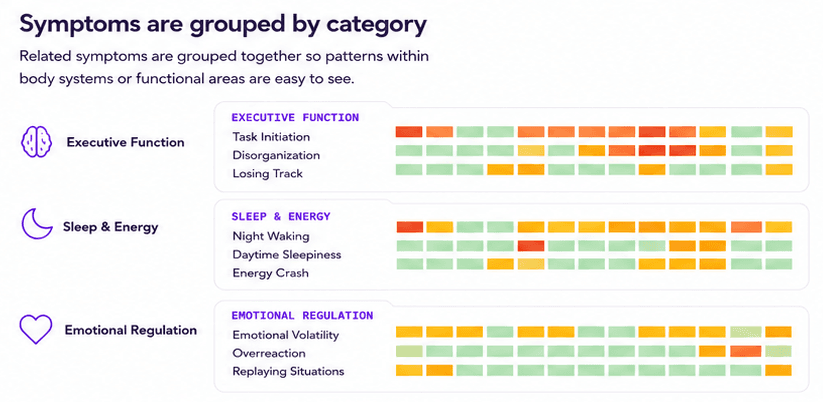
One of the first things you'll notice is that symptoms aren't listed alphabetically.
They're grouped into categories like:
- Executive Function
- Emotional Regulation
- Sleep & Energy
That wasn't just to make the symptom report look tidier, although it helps.
It's because symptoms often travel together.
Someone struggling with executive function is rarely dealing with just one problem. Difficulty starting tasks, losing track of what they were doing, disorganization and avoiding effort often show up together.
Grouping related symptoms makes those relationships much easier to see. Instead of hunting through a list of more than 100 symptoms, healthcare providers can quickly spot which body systems or functional areas are improving, worsening, or remaining stable.
Why symptom improvement is just as important as symptom severity
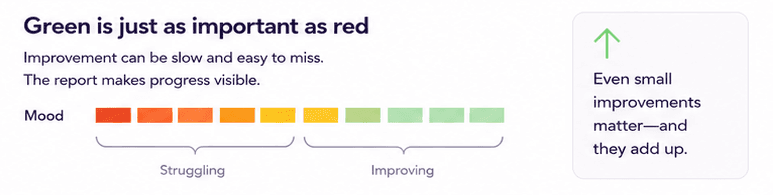
Most symptom trackers focus on what's wrong. We wanted to show what's getting better, too.
That might sound obvious, but our brains are surprisingly bad at recognizing gradual improvement.
One of our early users was trying different ADHD medications to help with emotional dysregulation and rejection sensitivity, but she couldn't tell whether they were actually working.
After a few months she generated her Fine clinician report, and immediately noticed something she hadn't consciously realized.
Those sections had quietly turned green.
She hadn't noticed because the improvement happened gradually. Life had simply become... easier. The report made that progress visible.
Another user had been struggling with almost no libido for months. Her symptom report showed solid red.
After starting low-dose testosterone, the colour shifted toward yellow.
Not perfect. But clearly better.
That's valuable information. Sometimes treatment doesn't eliminate symptoms. Sometimes it moves them from debilitating to manageable. That's progress too.
How medication tracking helps you see what changed
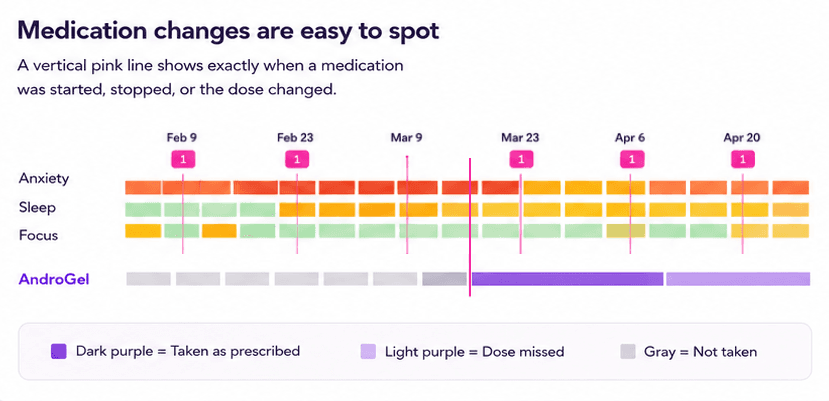
Fine combines symptom tracking with medication tracking so you can see whether changes in treatment actually affected your symptoms.
Notice the thin red vertical lines running through the symptom report.
Those aren't decorations.
They're markers showing exactly when a medication was started, stopped or the dose changed.
Because the important question isn't: "When did I start this medication?"
It's: "What happened after I started it?"
- Did my anxiety improve?
- Did my sleep get worse?
- Did my focus improve while emotional regulation stayed the same?
Instead of trying to mentally line up dates from your calendar with symptoms you vaguely remember, the symptom report places medication changes directly beside the symptom data so patterns become much easier to spot.
We include your cycle because hormones don't read calendars
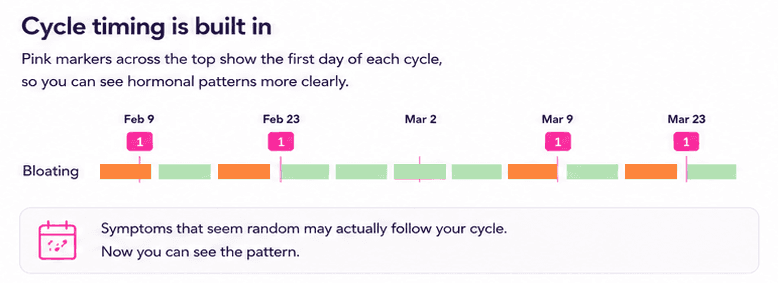
Hormonal symptoms often fluctuate with your cycle. But surprisingly, many cognitive and emotional symptoms do too.
Sometimes they worsen before bleeding.
Sometimes they disappear afterwards.
Sometimes they don't seem connected at all.
That's useful information.
By showing the first day of each cycle across the top of the symptom report, it's much easier to see whether symptoms appear randomly or whether they're following a hormonal pattern.
Sometimes what looks like unpredictable chaos is actually surprisingly consistent.
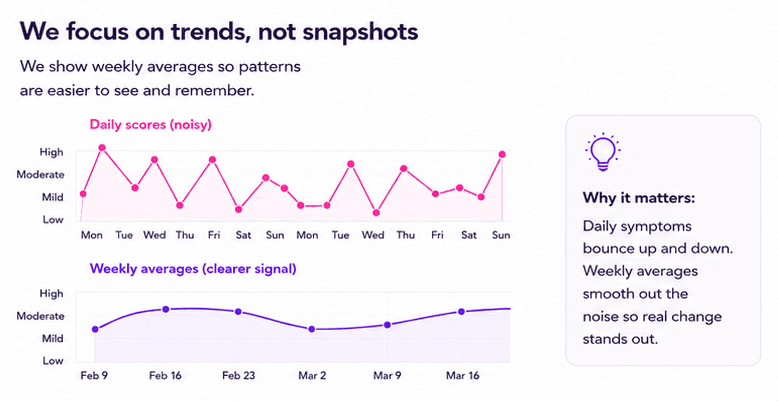
Why we use weekly averages instead of daily scores
This is probably the question we get asked most: Why not show every day's data?
Because daily symptom data is noisy. Symptoms naturally bounce around from day to day.
Life happens. You sleep badly. You catch a cold. You have a stressful week at work.
Looking at daily severity often makes everything look more chaotic than it really is.
Weekly averages smooth out those normal fluctuations while still making meaningful changes easy to see.
You lose a little detail, but you gain a much clearer picture of what's actually changing.
The signal becomes much clearer than the noise.
We deliberately don't ask you to track everything every day
There are more than 100 symptoms available to track in Fine. Could we ask you to rate every single one every day? Absolutely.
Would anyone keep doing it? Probably not.
Most symptom trackers quietly assume you'll become the world's most disciplined patient. They'll rate everything. Every day. Forever. But that's just not how real people work. So eventually... they just stop tracking.
We'd rather collect good information consistently than perfect information for four days.
Each week we average the data you've entered for each symptom.
That might sound like everything would end up somewhere in the middle. Interestingly, it usually doesn't. When symptoms are present, they're often consistently present. When they resolve, they often stay at zero. The averaging removes the daily volatility without hiding meaningful change.
Perfect data from imaginary users isn't nearly as useful as good data from real people.
The Fine report is designed to start better conversations
Fine doesn't diagnose perimenopause. It doesn't diagnose ADHD. It doesn't tell you which medication you should take.
That's your doctor's job.
Our job is simpler.
We help you walk into that appointment with something far more useful than: "I think I've been feeling worse..."
Instead, you can show:
- Which symptoms changed.
- When they changed.
- Whether they changed after medication adjustments.
- Whether they follow your cycle.
- Which areas of your life are improving.
- Which ones still need attention.
That's a much better place to start the conversation.
Better data. Better conversations.
The biggest lesson I've learned building Fine is that people aren't bad at tracking symptoms.
They're being asked to do something incredibly difficult: remember months of fluctuating symptoms, notice subtle changes, track medication effects, recognize patterns. Then accurately summarize all of it during a 15-minute appointment.
That's a lot to ask of anyone. Especially someone whose memory, attention, or executive function may already be struggling.
The goal of the Fine clinician report isn't to replace your healthcare provider. It's to give both of you the same thing: a clear picture of what's actually been happening.
Because when you can finally see the patterns, it's much easier to decide what to do next.
How to read your Fine clinician report
Rows = symptoms
Each row represents a single symptom you're tracking.
Columns = weeks
Each column represents one week within the specified time period.
Green = little or no symptom
Symptom boxes that are color coded green show that the user did not experience this symptom.
Yellow/Orange = increasing severity
Symptom boxes that are color coded yellow or orange show that the user moderately experienced this symptom, or that the symptom fluctuated up and down over the week.
Red = prominent, severe symptom
Symptom boxes that are color coded red show that the user had a severe experience of this symptom.
Grey = no reporting
No symptom data was recorded for this symptom during that week.
Pink vertical lines = medication changes
Represents a change in one or more medications. See details in the medication chart below the symptoms.
Pink markers across the top = cycle start dates
The pink boxes represent day 1 of the user's cycle.
Medications
Dark purple indicates the medication was taken every day that week. Lighter purple indicates one or more missed doses. Grey indicates the medication was not active during that period.
Summary table = symptom categories
Shows how symptom categories are changing over time.
Symptom Report Questions
Why should I bring a symptom report to my doctor?
+How long should I track symptoms before generating a report?
+Why doesn't Fine ask me to track every symptom every day?
+Can the Fine report help diagnose perimenopause, ADHD, anxiety, etc.?
+Can I bring the Fine report to any doctor?
+